

If you’re a fan of craft beer, you’ve likely come across the term “wheat beer” more than once. But what, exactly, is a wheat beer, and what makes it so special? Spoiler alert: it isn’t just the wheat that makes this beer delicious (although that is a big part of it). Keep reading to learn more about wheat beer and what sets it apart as one of the tastiest, most drinkable brews out there.
It is a fairly common misconception that all beer contains wheat. In fact, most beer does not contain wheat, but rather a combination of hops, yeast, water, and malt. Malt is a general term for a grain, but it is usually in the form of rye, oats, barley, or even flaked rice.
Wheat beer uses a good percentage of malted or unmalted wheat as its primary grain. The use of wheat gives these beers a distinctly smooth, creamy mouthfeel and a slightly hazy appearance. Wheat beers are known for their refreshing qualities, making them an ideal choice for warm weather or any occasion that calls for a light, easy-drinking beer.
Wheat beers have a rich history that dates back to ancient times. However, the modern wheat beer we know today has its roots in Europe, particularly in Germany and Belgium (shocker, we know).
German wheat beers, known as “Weißbier” or “Hefeweizen,” and Belgian wheat beers, called “Witbier,” are the two most famous styles. Interestingly, these names do not translate to “wheat beer” but to “white beer.” It is predominantly a reference to the paler, air-dryed malt used versus the brown, toasted malt of other styles. Turns out, though, that “wheat” and “white” have a shared etymology in West Germanic languages, including English.

You may recall from our adorable post on Kolsch that there were once strict regulations in Germany on the production of beer. The Reinheitsgebot (“Purity Law”) stipulated that beer could only be made with barley and top-fermenting yeast. This changed in 1548, when the Duke of Bavaria gave Baron Hans Sigmund of Degenberg (great name) a special permit to produce and sell wheat beer to the neighboring regions of Bohemia. He still had to use top-fermenting yeast, though.
Eventually, the privilege of producing what beer was transferred to the ruling House of Wittelsbach (it’s like beer Game of Thrones over here). In true “ruling house” fashion, they forced every innkeeper in the region to purchase only wheat beer from their breweries. The irony is that this happened under the direction of Maximilian I, the grandson of Duke Albrecht V, who had previously declared his distaste for wheat beer and outlawed its production among “ordinary” brewers.
Anyway, the Wittlesbachs hung on for another couple of centuries before they sold their wheat beer privileges to the Georg Schneider brewery. Although it may not be among the ranks of Paulaner or Maisel, the weißbier produced by G. Schneider & Sohns is still produced today and sold to 27 different countries worldwide.
Witbier (a.k.a. biere blanche in French-speaking regions) in Belgium also dates back to the 16th century, but it was not subjected to the stringent rules of the Reinheitsgebot (RRRR-AAAY-NNNN-HIIII-TSSSS-GUH-BOAT). Belgian and Dutch brewers traditionally used raw, unmalted barley that was dried in attics where a gentle breeze could dry it and maintain its natural, pale color. Wow, Belgian brewing is literally a breath of fresh air compared to German brewing.
Today, you may be familiar with the brands Hoegaarden and Leuven, which have survived since the early days of witbier brewing. Although they saw a dip in sales for a time, Pierre Celis is credited with re-popularizing the witbier at home and internationally. He maintained the traditional method of at least 50% raw wheat while adding subtle notes of coriander and orange for added refreshment and flavor. The orange also enhances the slightly sour flavor of the beer, which comes from higher levels of lactic acid.
Wheat beers are renowned for their light, fruity, and sometimes slightly spicy flavors. The use of wheat in the brewing process imparts a soft, bready quality, while the yeast strains used in fermentation often contribute notes of banana, clove, and even bubblegum in some varieties. In the case of our “Mötley Hüe,” the addition of pineapple, mango, orange and banana adds a delightful burst of sweetness and tanginess. This combination makes it even more refreshing.
While beer should always be enjoyed in moderation, wheat beer does have some health benefits compared to other styles. The higher protein content in wheat can lead to more filling and satisfying beer, which might help you drink less overall.
Additionally, wheat beers often have a lower alcohol content, making them a lighter option for those who are health-conscious. Some studies have even suggested that the polyphenols found in wheat beer may have antioxidant properties, though more research is needed to fully understand these potential benefits.
All beer can generally be classified as an ale or a lager (or a hybrid). Wheat beer is, technically, an ale. It is brewed with top-fermenting yeast at warmer temperatures (around 60-70 degrees Fahrenheit). By contrast, lagers are brewed at colder temperatures using bottom-fermenting yeast. Ales, such as wheat beers, can be made much more quickly than lagers, since the higher temperatures speed up the fermentation process.
Americans, as a rule, don’t like…rules (that there’s what you call “verbal irony”). This means that, while we draw inspiration from all beer styles, we can often be more free-wheeling in our methods. Hybrids are popular among craft brewers, like a beer made with top-fermenting yeast but conditioned at colder temperatures. Or, say, a wheat beer that has been “fruited” like a lambic, but uses a cultivated yeast strain instead of a wild one.
For our part, we also tend to go bigger or go home, which means we use more of everything. If it’s a wheat beer, then we’re using ALL the wheat. If it’s supposed to taste like banana, then banana you shall have. We are unabashedly unbashful in our flavor pursuits, and we think it often results in the most exciting creations.
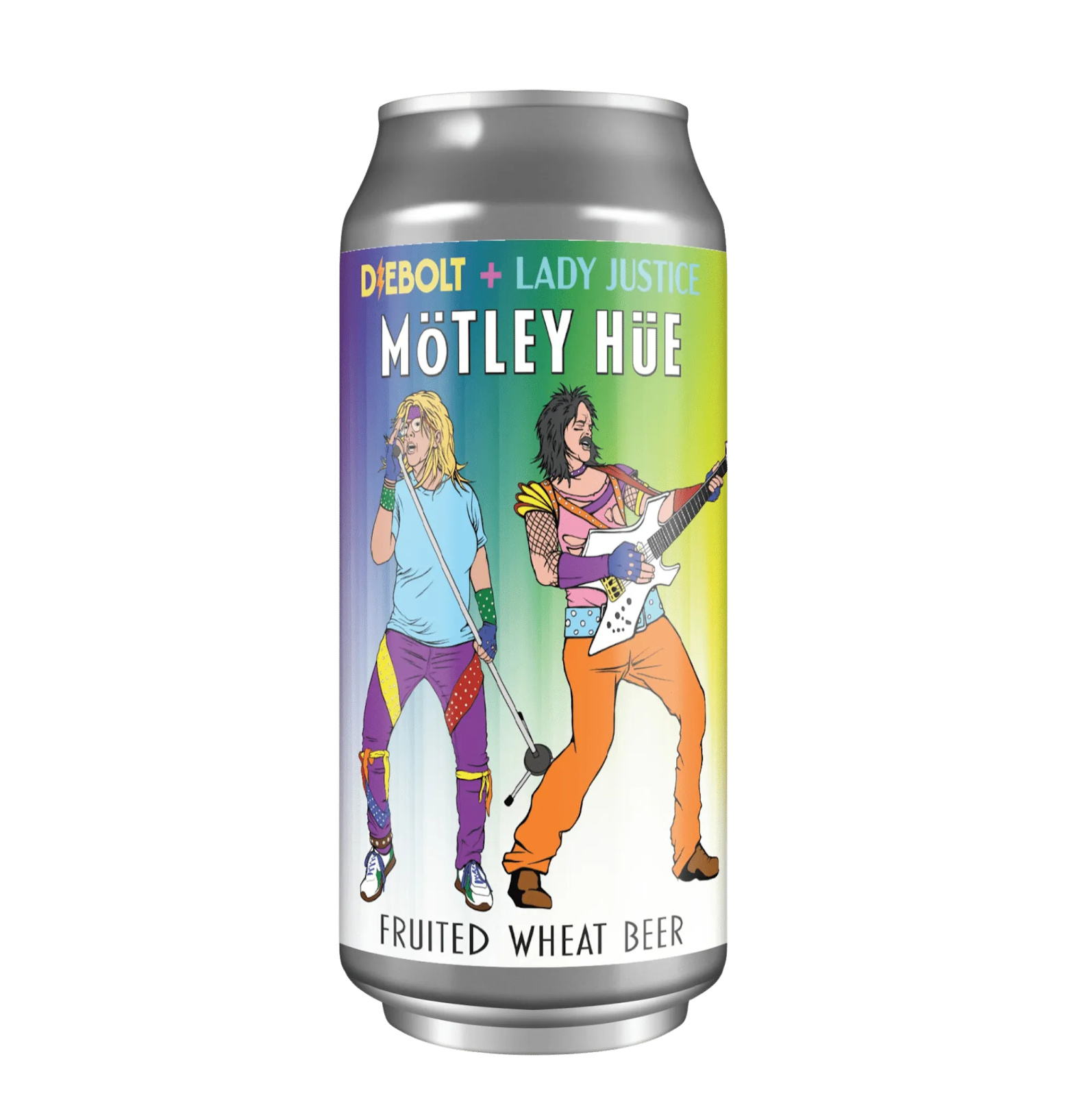
You want wheat beer, you GOT wheat beer. Our latest beer drop, Mötley Hüe, is made with a whopping 65% wheat malt, further breadified by German wheat yeast, and delightfully bolstered with the fruity flavors of pineapple, mango, orange, and banana. It’s creamy, bubbly, tangy, and refreshing. Come on down to our brewery on Mariposa to try it on tap or take a few cans home. Hüe simply MUST give this beer a try.


